
What’s In This Guide
- Quick Answer: What Does a Commercial Mover Handle During Office Reconfiguration?
- Why Workplace Consolidation Projects Need More Than a Standard Move
- Common Mistakes Companies Make When Reconfiguring Existing Space
- Reuse, Store, or Dispose: Comparing Furniture and Equipment Options
- How to Plan an Office Reconfiguration Step by Step
- Coordination Factors That Shape a Workplace Consolidation Timeline
- When to Bring in a Commercial Mover for Office Reconfiguration
- Frequently Asked Questions
- Ready to Plan Your Office Reconfiguration?
Companies shrinking their footprint or redesigning existing space face a different challenge than a standard relocation. A commercial mover brings the same planning discipline to office reconfiguration that a full building move requires, just applied to a space the business already occupies.
Quick Facts
- Office reconfiguration projects require employee-seat mapping before furniture moves, not after, to avoid reassigning desks twice.
- A reuse, store, or dispose framework helps companies decide what happens to surplus furniture and equipment during workplace consolidation.
- OSHA’s walking-working surfaces standard, 29 CFR 1910.22, requires aisles and passageways to stay clear, a requirement that shifts every time furniture is reconfigured.
- IT reconnection works best sequenced by department rather than handled as a single all-at-once cutover, which limits downtime in occupied offices.
- Refurbished or donated office furniture can offset disposal needs, an option recognized in EPA’s sustainable materials management guidance for office furniture.
Quick Answer: What Does a Commercial Mover Handle During Office Reconfiguration?
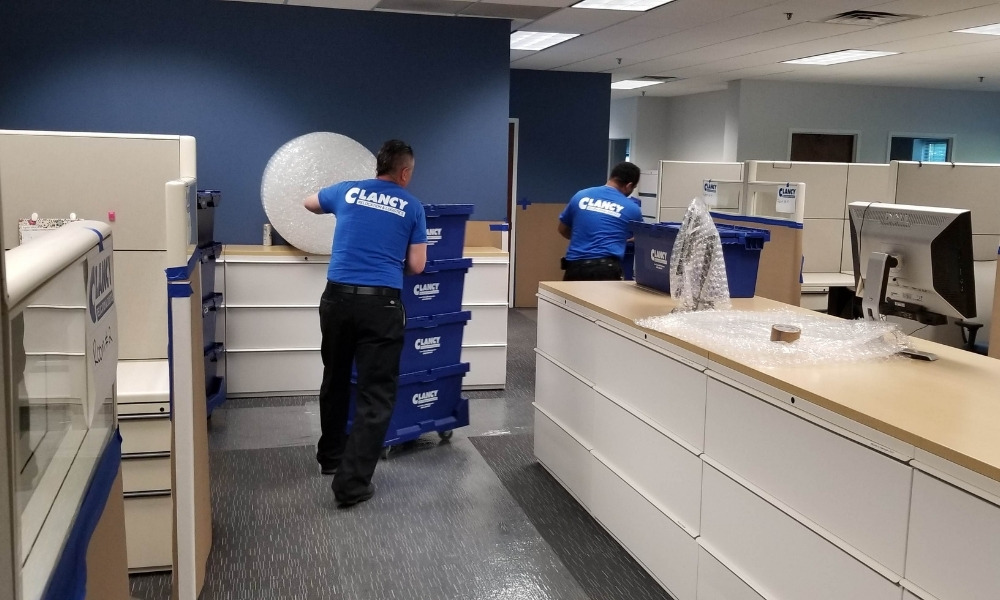
A commercial mover handles furniture disassembly and reassembly, modular furniture relocation within the building, surplus storage, and coordinated department sequencing. For workplace consolidation, the mover also supports asset disposition and timing around IT reconnection, working around a business that stays open during the project.
Why Workplace Consolidation Projects Need More Than a Standard Move
Working Within a Space the Business Already Occupies
A workplace consolidation project moves people and furniture within walls the business already occupies, often while employees keep working. That constraint changes the planning approach compared to moving into a new building.
Sequencing Departments to Limit Disruption
Companies reducing square footage or merging departments into shared space need a sequence that avoids displacing an entire team at once. A phased plan lets one department relocate while another continues working nearby, which limits the operational disruption a company absorbs during the project.
Planning for Modular Furniture Relocation
Modular furniture relocation adds another layer of planning. Workstations designed for reconfiguration still require disassembly, transport within the building, and reassembly to the new seat map, work that benefits from the same project coordination a commercial mover applies to a full office relocation.
Decisions a Full Relocation Avoids
Consolidation projects involve decisions that a full relocation may not require. Each department must determine what stays in use, moves to storage, or no longer fits the available space.
For Manhattan facilities receiving imported furniture or equipment, port-to-Manhattan freight drayage and delivery may also need to be coordinated with installation schedules and building access.
Common Mistakes Companies Make When Reconfiguring Existing Space
Office reconfiguration involves overlapping responsibilities, tight schedules, and potential disruptions to daily operations. An office relocation risk register helps facilities teams document potential issues, assign responsibility, and plan corrective actions before furniture or equipment moves.
- Starting furniture moves before seat mapping is finalized. Moving desks without a confirmed seat assignment often means moving the same furniture twice.
- Treating surplus furniture as an afterthought. Waiting until after the reconfiguration to decide what happens to unused furniture creates storage and disposal problems under time pressure.
- Scheduling IT reconnection as a single cutover. Disconnecting every department’s network access at once increases downtime instead of limiting it to one area at a time.
- Underestimating aisle and clearance requirements. A tighter furniture layout can block walkways that need to stay clear for daily movement and emergency egress.
- Not sequencing departments around daily operations. Reconfiguring a customer-facing team during business hours creates more disruption than scheduling that work after hours or on a weekend.
- Skipping a documented asset inventory. Without a list of what furniture and equipment exist before the project starts, surplus items are harder to track through reuse, storage, or disposal.
- Assuming one department’s timeline applies to the whole project. A department with simple workstation needs may finish in a day, while a department with specialized equipment or more network connections can take considerably longer, and a single shared deadline can leave the more complex team short on time.
Reuse, Store, or Dispose: Comparing Furniture and Equipment Options
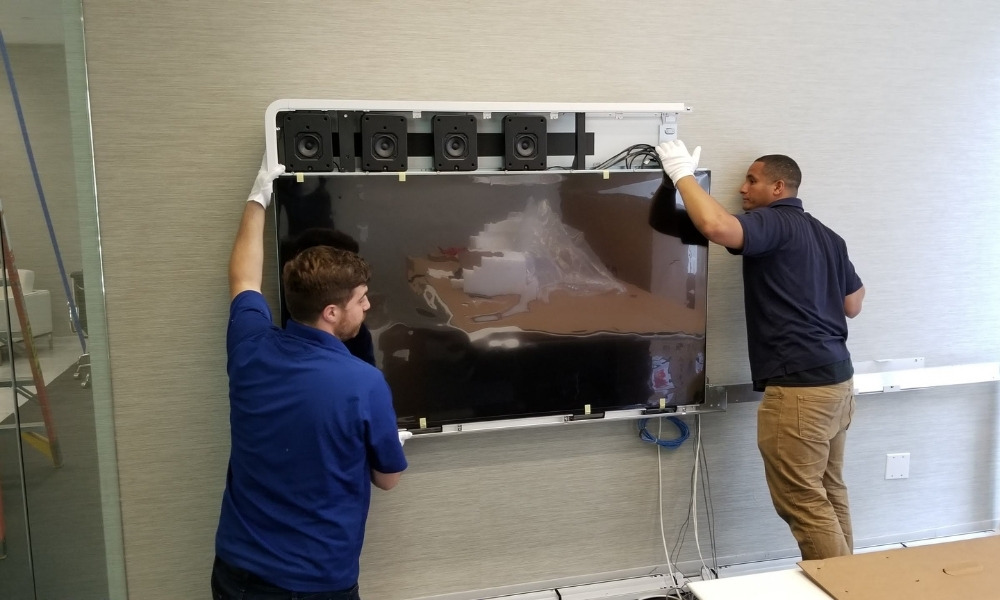
Workplace consolidation often produces surplus furniture and equipment. Each item generally falls into one of three paths: reuse, storage, or disposal. For businesses managing temporary space restrictions, NYC warehouse staging can accommodate furniture and equipment awaiting reinstallation or delivery. The right choice depends on condition, future space needs, and how soon each item will be needed again.
|
Option |
What It Means |
Best For |
Key Consideration |
|
Reuse |
Furniture relocates within the building into the new layout |
Modular systems and workstations still in good condition |
Requires disassembly, transport, and reassembly to the new seat map |
|
Store |
Furniture and equipment move to off-site storage |
Items tied to future growth or a department expected to expand later |
Needs a storage plan with inventory tracking for retrieval |
|
Dispose |
Furniture is donated, recycled, or discarded |
Items no longer needed or not worth relocating |
Donation or recycling can offset disposal costs over discarding outright |
EPA’s guidance on recycled content and refurbished office furniture notes that furniture can be refurbished or remanufactured rather than replaced, which supports the reuse and donation paths for companies weighing their options.
How to Plan an Office Reconfiguration Step by Step
Step 1: Map Employee Seating Before Scheduling Any Moves
Finalize the new seat chart first, including which teams sit together and which workstations change size or location. This step prevents furniture from being placed, then moved again once assignments change.
Step 2: Inventory Furniture and Equipment Against the Reuse, Store, or Dispose Framework
Walk the current space and log every furniture item and piece of equipment against the reuse, store, or dispose framework. A documented inventory helps determine where each asset belongs and whether it remains suitable for use. For businesses consolidating office and distribution operations, order profiling in Albany 3PL fulfillment workflows can also inform how inventory is organized and handled during operational changes.
Step 3: Sequence Departments to Limit Disruption
Group the reconfiguration into phases by department or floor section rather than attempting the entire space at once. Facility teams typically schedule the first phase around a department that can temporarily work from a conference room or shared space.
Step 4: Coordinate IT Reconnection Around the Move Sequence
Align network, phone, and workstation reconnection with the same department sequence used for furniture moves. Keeping access to active drops wide enough for a cart or crew also supports OSHA’s walking-working surfaces requirement for clear aisles and passageways, which applies to office space during and after reconfiguration.
Step 5: Confirm the New Layout Before Declaring the Project Complete
Walk the finished space against the original seat map and inventory list. Confirm surplus items reached their intended path, whether that is storage, donation, or disposal, before closing out the project.
Coordination Factors That Shape a Workplace Consolidation Timeline
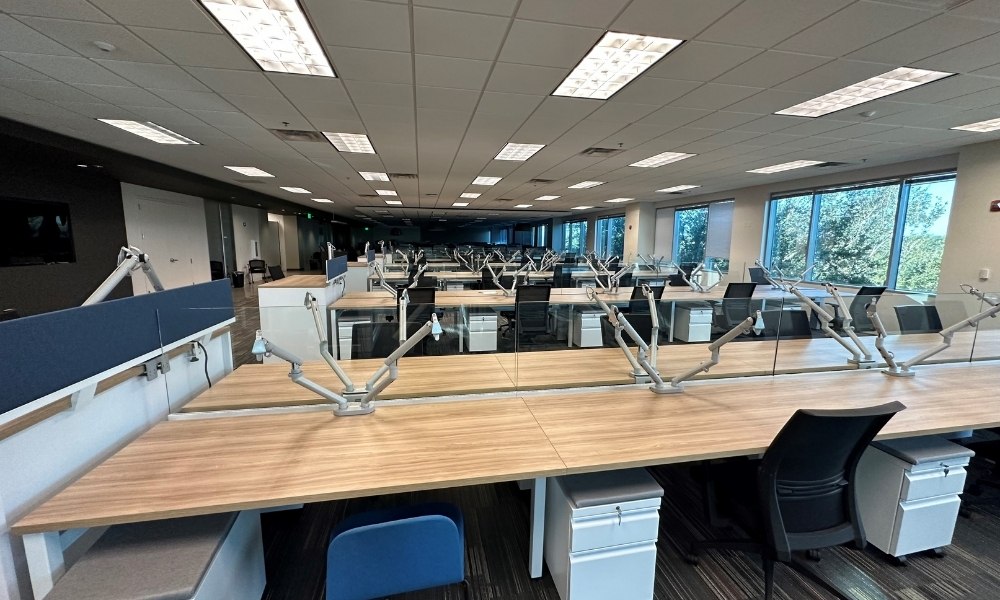
A reconfiguration timeline depends on a handful of planning factors rather than square footage alone:
- Department sequencing. More phases generally mean a longer overall timeline but less disruption per department at any one time.
- Furniture condition and age. Older modular systems may need additional disassembly time or parts that are harder to source for reassembly.
- IT and network complexity. A department with more workstations, shared equipment, or specialized connections needs more coordination time during reconnection.
- After-hours access. Projects scheduled around business hours often depend on evening or weekend access to limit disruption to daily operations.
- Surplus volume. A large amount of surplus furniture extends the timeline for sorting between reuse, storage, and disposal.
- Building access windows: Shared elevators, loading docks, and freight access can limit when furniture moves between floors or storage areas. When surplus equipment requires commercial freight shipping, applicable NMFC freight classification changes may also affect transportation planning and costs.
When to Bring in a Commercial Mover for Office Reconfiguration
Coordinating Multiple Moving Parts
A facilities team managing seat mapping, furniture disassembly, surplus sorting, and IT coordination across several departments benefits from a single point of coordination. This is where a commercial mover supports a workplace consolidation project beyond moving boxes from one room to another.
Managing Multi-Department Projects and Tight Deadlines
Companies handling a multi-department reconfiguration, a tight completion deadline, or a mix of reuse, storage, and disposal decisions typically see fewer scheduling conflicts when one team manages furniture handling, surplus storage, and project sequencing from start to finish.
When Internal Management Is Enough, and When It Isn’t
That coordination becomes more valuable as the number of departments grows. A facilities team tracking seat assignments, surplus decisions, and IT timing for two departments can often manage the project internally, while a consolidation touching five or more departments usually benefits from a dedicated project plan that keeps every phase on the same schedule.
Frequently Asked Questions
What factors affect the cost of an office reconfiguration project?
Cost depends on the scope of furniture disassembly and reassembly, how many departments are involved, whether items are reused, stored, or disposed of, and how much IT and electrical work the reconnection requires. A walkthrough with a commercial mover is typically the most reliable way to get an accurate picture for a specific space.
What is the difference between an office reconfiguration and a renovation?
An office reconfiguration focuses on furniture layout, seating, and space usage within existing walls, while a renovation typically involves construction work such as new walls, flooring, or building systems. Many projects involve only reconfiguration, though some may require minor renovation work depending on the scope.
Is workplace consolidation the same as office reconfiguration?
The two terms overlap but aren’t identical. Workplace consolidation usually means combining departments or shrinking the overall footprint, while office reconfiguration can also include redesigning a layout without necessarily reducing space. Many projects involve both at the same time.
Do employees need advance notice before a reconfiguration project begins?
Yes. Giving employees advance notice about phase timing, temporary seating, and any changes to their workstation helps reduce confusion once the project is underway. How much notice is needed depends on how disruptive each phase is expected to be.
Does an office reconfiguration project require special permits or approvals?
It depends on the scope of the work. Simple furniture moves usually don’t require permits, but projects involving electrical changes, structural work, or building modifications may need approval from property management or local authorities.
Ready to Plan Your Office Reconfiguration?
Coordinating seat mapping, furniture handling, surplus decisions, and IT reconnection across departments takes experienced project management.
Clancy Relocation & Logistics supports businesses through office reconfiguration and workplace consolidation projects, coordinating furniture, storage, and scheduling around a company that stays open.
Contact our team to discuss a project plan for an upcoming office reconfiguration.