
What’s In This Guide
- What Does Safe Freight Transportation Look Like for Sensitive Optics Equipment?
- Why Freight Transportation Services Matter for Rochester’s Precision Manufacturers
- What Can Go Wrong in Transit: Common Risks for Precision Equipment
- How to Plan a Safe Freight Move for Sensitive Equipment
- Transport Risk Matrix: Matching Planning to Equipment Sensitivity
- Timeline, Coordination, and Cost Factors to Plan For
- When Should Rochester Companies Bring in a Specialized Freight Partner?
- Frequently Asked Questions
- Ready to Plan a Safe Freight Move for Your Rochester Facility?
Rochester serves as a hub for optics, photonics, and imaging innovation. For the companies operating in this sector, moving precision equipment is a routine yet high-stakes requirement. Because delicate optical benches and sensitive sensors are vulnerable to vibration, temperature fluctuations, and handling errors, standard shipping methods may not provide sufficient protection. Success requires a specialized approach focused on vibration management, climate control, and rigorous safety compliance.
Quick Facts
- Rochester anchors a regional optics, photonics, and imaging cluster of more than 75 companies and over 18,000 employees, making precision equipment freight a routine, high-stakes need across the Finger Lakes region.
- ASTM D4169 provides a uniform laboratory-testing framework for evaluating shipping units against anticipated hazards encountered during distribution.
- For construction work covered by 29 CFR 1926.251, OSHA requires rigging equipment for material handling to be inspected before use on each shift and prohibits loading it beyond the manufacturer’s recommended safe working load.
- Before booking an interstate freight move, facilities should verify that the motor carrier has the FMCSA registration and USDOT number required for its operation.
- Air-ride trailer suspension and climate-controlled trailers can help address common transport risks for sensitive photonics equipment, including road vibration and environmental exposure.
What Does Safe Freight Transportation Look Like for Sensitive Optics Equipment?

Sensitive equipment shipping for optics, imaging, and photonics equipment combines custom crating built to exact dimensions, shock and tilt indicators, rated load securement, and documented handoffs from pickup to final placement. Climate control can help manage environmental conditions, while air-ride trailers can help reduce road vibration.
These safeguards work best as a coordinated system. Custom crating can limit internal movement, air-ride transportation can reduce road vibration, climate control can manage temperature and humidity exposure, and proper load securement can help prevent shifting. Freight transportation services for sensitive equipment should combine these measures according to the equipment and route.
Why Freight Transportation Services Matter for Rochester’s Precision Manufacturers
Rochester’s manufacturing base includes an unusually dense concentration of optics, imaging, and photonics companies, which raises the stakes on every equipment move. Rochester anchors a regional cluster of more than 75 companies and over 18,000 employees, making precision equipment freight a routine, high-stakes need across the Finger Lakes region.
The University of Rochester serves as a founding partner in a national photonics manufacturing institute headquartered in the city, reflecting decades of regional expertise in precision optics that trace back to the city’s legacy imaging and lens-making industries.
Precision equipment may move between labs, cleanrooms, test facilities, and manufacturing floors during relocations, expansions, equipment upgrades, or project changes. Poor handling can cause equipment damage, calibration issues, and schedule delays, so each move should be planned around the equipment’s sensitivity and handling requirements.
For facilities teams, freight transportation services must address more than pickup and delivery windows. Planning should account for vibration, handling, environmental exposure, load securement, and final placement throughout the move.
What Can Go Wrong in Transit: Common Risks for Precision Equipment
Vibration and Mechanical Shock
Interferometers, laser benches, and imaging sensors rely on tight mechanical tolerances. Continuous road vibration and sudden shock events, such as hard braking or dock plate transitions, can knock optical alignments out of spec even when the exterior housing shows no visible damage.
To mitigate these threats, the industry relies on standards like ASTM D4169, which provides a uniform laboratory-testing framework for evaluating whether shipping units can withstand anticipated hazards encountered during distribution.
Temperature and Humidity Swings
Precision optics and electronic assemblies are sensitive to rapid temperature or humidity changes, particularly condensation that forms when equipment moves between a climate-controlled facility and an unconditioned trailer. Coatings, adhesives, and electronic components can all be affected by conditions outside their designed operating range.
Improper Load Securement and Rigging
Heavy optical benches, imaging systems, and manufacturing equipment often require rigging to load and unload safely. Rigging equipment that isn’t inspected or rated for the load introduces real safety risk for crews and real damage risk for the equipment itself.
Missing or Incomplete Documentation
Equipment moving between facilities, especially across state lines, needs a documented handoff trail. Gaps in that trail make it harder to confirm equipment condition at each stage and complicate any claim if something goes wrong.
How to Plan a Safe Freight Move for Sensitive Equipment

Step 1: Build Custom Crating Around the Equipment’s Exact Dimensions
Standard boxes and generic pallets leave too much room for movement inside the container. Custom crating, built to the equipment’s exact footprint, limits internal shifting and adds a structural buffer between the equipment and outside impact.
Step 2: Install Shock and Tilt Indicators Before Loading
Shock and tilt indicators attach directly to the crate and indicate whether the load exceeded preset impact or tilt thresholds during transport. This gives receiving teams a documented checkpoint before unboxing or calibration.
Step 3: Secure the Load With Rated Rigging Equipment
Rigging gear used to lift heavy equipment should have legible load-rating markings and be inspected before use. For construction work covered by 29 CFR 1926.251, OSHA requires rigging equipment for material handling to be inspected before use on each shift and prohibits loading it beyond the manufacturer’s recommended safe working load.
Step 4: Choose Air-Ride or Climate-Controlled Trailers When Conditions Call for It
Air-ride transportation can help reduce road vibration, while climate-controlled trailers can limit temperature and humidity swings for equipment with tight environmental tolerances. The appropriate trailer setup should be based on the equipment’s sensitivity, route, trip duration, and handling requirements.
Step 5: Maintain Documentation From Pickup to Final Delivery
A written record covering pickup condition, in-transit handling, and delivery condition creates accountability at every stage. This is especially important for equipment moving across state lines, where multiple parties or facilities may be involved in the handoff.
Step 6: Prepare the Delivery Site for Precise Final Placement
Final placement requires advance planning. Before the truck arrives, facilities teams should confirm dock access, floor load capacity, doorway clearances, and any rigging required to move the equipment into position.
READ MORE: 5 Packing and Storage Tips for a Stress-Free Long-Distance Move
Transport Risk Matrix: Matching Planning to Equipment Sensitivity
Not every piece of equipment needs the same level of planning. This matrix compares common equipment profiles across sensitivity, value, size, and environmental tolerance to help facilities teams scope the right level of transport planning.
|
Equipment Profile |
Sensitivity Level |
Typical Value Tier |
Size and Handling Factors |
Environmental Tolerance |
Recommended Planning Tier |
|
Optical benches, interferometers, laser systems |
High |
High value |
Compact to mid-size, precision-aligned |
Low tolerance for vibration and humidity |
Custom: shock-indicated crating, air-ride, climate control |
|
Imaging systems, cameras, sensor arrays |
Moderate to high |
Mid to high value |
Compact, lens and sensor sensitive |
Moderate, sensitive to shock |
Enhanced: custom crating with shock indicators |
|
Cleanroom and manufacturing line equipment |
Moderate |
Mid to high value |
Large, heavy, often requires rigging |
Moderate, sensitive to tilt during transit |
Enhanced: rated rigging plus secured load |
|
Lab furniture, workstations, general fixtures |
Low to moderate |
Standard value |
Bulky, standard handling |
Higher tolerance |
Standard: padded wrap and standard freight |
Timeline, Coordination, and Cost Factors to Plan For
Costs for sensitive equipment freight vary with equipment size and weight, custom crating, rigging, distance, trailer type, site access, and scheduling requirements. Accurate pricing depends on the specific equipment and move conditions.
Lead time matters as much as budget. Custom crating, specialized trailers, and rigging crews may require advance scheduling. Sharing equipment dimensions, weight, handling requirements, and destination access details early helps the freight provider build a more accurate schedule.
When Should Rochester Companies Bring in a Specialized Freight Partner?
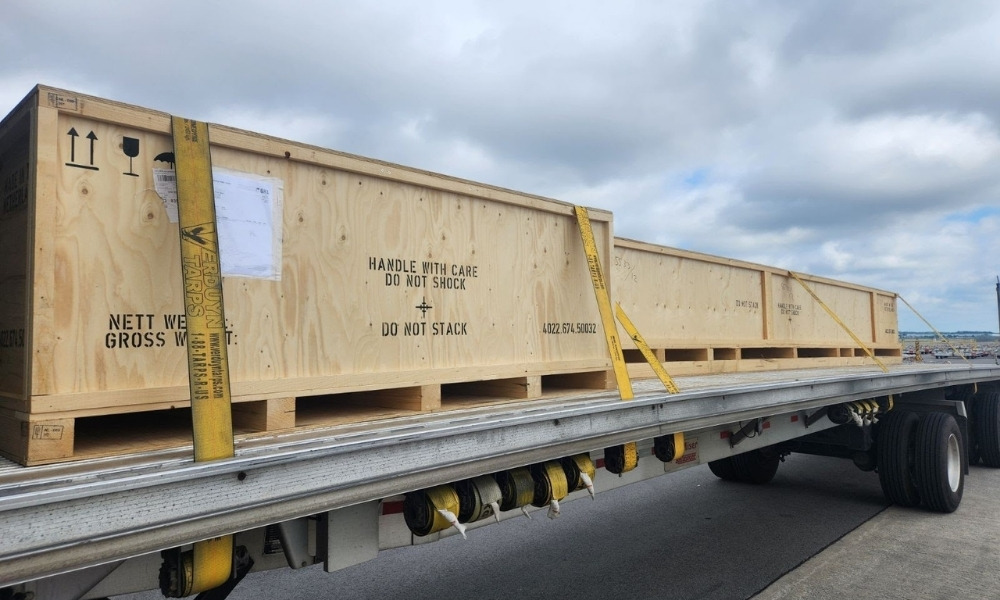
Some equipment moves are simple enough to coordinate internally. Others call for a freight partner with crating, rigging, and climate-controlled trailer capabilities built specifically for sensitive loads. For interstate freight, facilities should verify that the motor carrier has the FMCSA registration and USDOT number required for its operation before booking the move.
A specialized partner makes sense when:
- The equipment requires rigging to load, unload, or maneuver into its final position
- The move crosses state lines and requires an appropriately registered interstate motor carrier
- The equipment has tight environmental tolerances that call for climate-controlled or air-ride transport
- Multiple pieces of equipment need to move on a coordinated schedule tied to a lab buildout, facility relocation, or production timeline
Frequently Asked Questions
What is air-ride transportation and why does it matter for sensitive equipment?
Air-ride transportation uses air-filled suspension bags instead of standard leaf springs to absorb road vibration. For precision equipment with tight alignment tolerances, this reduces the risk of components shifting or misaligning during transit.
How far in advance should a photonics or optics company plan an equipment transport?
Equipment transport involving custom crating, rigging crews, or specialized trailers generally needs more lead time than standard freight. Sharing equipment dimensions, weight, and destination access details early gives the transport team enough time to schedule the right crating, crew, and trailer type.
What documentation should accompany sensitive equipment during freight transport?
A documented handoff should confirm equipment condition at pickup, note any shock or tilt indicator readings during transit, and record condition at delivery. This documentation matters most for equipment moving across state lines or between multiple facilities.
Can precision optics equipment be transported safely during winter weather?
Yes, with the right preparation. Climate-controlled trailers help limit temperature and humidity swings during cold-weather transport, and additional lead time is often needed to account for weather-related routing or scheduling adjustments.
Who should Rochester businesses contact for specialized freight transport of sensitive equipment?
Facilities managing optics, imaging, or laboratory equipment should work with a freight provider experienced in custom crating, rated rigging, and climate-controlled or air-ride transport. For interstate moves, facilities should verify that the motor carrier has the FMCSA registration and USDOT number required for its operation.
Ready to Plan a Safe Freight Move for Your Rochester Facility?
Moving precision equipment requires careful coordination, appropriate handling methods, and a transportation plan built around the equipment’s size, sensitivity, access requirements, and destination.
Clancy Relocation & Logistics provides specialized freight transportation for optics, imaging, laboratory, and precision-manufacturing equipment and operates under active USDOT Number 265038. Facilities teams receive a coordinated relocation plan that accounts for equipment handling, site access, transportation, and final placement requirements.
If your Rochester facility is planning sensitive equipment shipping, including high-value electronics freight, contact Clancy Relocation & Logistics to discuss the project scope, handling requirements, and next steps.